Coating Technology
Benefits of Silver-Infused Coatings
Aesthetic, antimicrobial, and longevity benefits
July 7, 2026
Real silver coatings deliver true silver reflectance, antimicrobial surface behaviour, and decades-long colour stability.
The Argentum Effect: A Definitive Examination of .999 Fine Silver in Architectural Coatings
Before the codification of color, there was the foundational interplay of light and substance. True silver—Argentum—does not possess a color in the traditional sense; it is a near-perfect manipulator of light. To coat a surface with .999 fine silver is not merely to decorate it, but to fundamentally alter its relationship with the photons that define its space. This is the domain not of ordinary paint, but of applied material science.
In architectural coatings, most “silver” finishes are not silver at all. They are interpretations of silver: aluminum flakes, mica-based pearlescents, synthetic metallic pigments, or grey pigments designed to simulate a metallic impression. These materials can be beautiful, but they do not carry the same optical identity, elemental purity, or material behavior as actual .999 fine silver. A true silver-infused coating begins with a fundamentally different premise: the surface is not merely colored silver; it contains silver.
For Aether Vernice, this distinction is central. A .999 fine silver coating is designed as a luminous architectural material: a finish that interacts with light, color, surface geometry, and spatial atmosphere in ways conventional wall paint cannot. Silver is prized in optical applications because protected silver mirrors offer exceptionally high reflectance across the visible and near-infrared spectrum, and technical sources describe silver as among the highest-reflectance metallic mirror materials available.
Distinguishing Elemental Purity from Common Metallic Finishes
Beyond Aluminum and Mica: The Spectrographic Difference
Common metallic wall finishes typically rely on aluminum, bronze powders, pearlescent mica, synthetic interference pigments, or reflective mineral platelets. These materials create a metallic effect by scattering and reflecting light from suspended particles within a binder. They can appear satin, pearlescent, frosted, or glittered depending on particle shape, size, and orientation.
True silver behaves differently. Elemental silver has a distinct reflectance profile that is neither simply grey nor merely shiny. It is optically neutral, highly reflective, and capable of delivering a cooler, cleaner, more luminous metallic depth than silver-hued pigment systems. Aluminum can be bright, but it often carries a sharper industrial tone. Mica can be elegant, but it frequently creates pearlescent diffusion rather than the dense, liquid-metal character associated with real precious metal.
Silver occupies a more refined visual category: less theatrical than glitter, less flat than grey, and less synthetic than imitation metallic pigment.
The result is not just a different color. It is a different material response.
A Foundation in Purity: The Significance of the .999 Standard
The .999 standard means the silver is 99.9% pure, commonly known as “three nines fine” silver. In bullion and precious-metal terminology, this distinction separates fine silver from sterling silver, which is typically 92.5% silver alloyed with other metals for hardness.
For architectural coatings, purity matters because the goal is not to create jewelry-grade hardness; the goal is optical and material authenticity. The silver is not being formed into a fork, ring, or structural object. It is being refined into particles and suspended within a coating system where its reflectance, chromatic neutrality, and precious-metal identity are the defining attributes.
A .999 fine silver coating therefore begins with a cleaner elemental foundation. Fewer alloying metals means fewer unwanted undertones, fewer variables in optical behavior, and a more direct connection between the visible finish and the elemental identity of silver itself.
The Psychophysical Perception of True Silver vs. Silver-Hued Pigments
Designers understand that perception is not limited to color value. A surface can share the same approximate HEX code as another material and still feel completely different in person. This is because the eye does not perceive color in isolation. It perceives color through gloss, depth, reflectance, grain, texture, light angle, and contrast with surrounding materials.
A silver-hued paint may match a grey-silver color chip under one lighting condition, yet appear flat or artificial when applied to a large wall. A real silver-infused coating behaves with greater complexity. As the viewer moves, the surface shifts subtly. Highlights travel across the film. The tone remains cool and composed, but the light response feels more dimensional.
This is the Argentum Effect: the perception that the wall is not simply painted, but activated by a precious material.
The Physics of Light: Specular Reflectance and Luminous Flux
The Principle of Specular versus Diffuse Reflection
Reflection occurs in two primary modes: diffuse and specular. Diffuse reflection scatters light in many directions, producing a soft, matte appearance. Specular reflection returns light more directionally, producing sharper highlights, metallic sheen, and mirror-like behavior.
Most architectural paints are dominated by diffuse reflection. Their pigments scatter light broadly, creating an even field of color. This is desirable for standard wall finishes because it hides imperfections and provides predictable color coverage. Metallic coatings introduce specular behavior by suspending reflective particles within the film.
A fine silver coating is engineered to balance these two modes. It cannot behave like a polished mirror, because an architectural surface must remain usable, durable, and visually integrated. But it can introduce controlled specular reflectance, allowing the wall to capture and return light in a way that creates movement, luminosity, and depth.
Maximizing Luminous Flux with Micron-Refined Platelets
Luminous flux refers to the perceived power of visible light. In design terms, a surface that returns light efficiently can make a room feel brighter, more dimensional, and more visually alive.
In a coating, the key is not simply adding silver. The silver must be refined into an appropriate particle geometry and distributed in a stable suspension. Micron-refined platelets can create broad reflective faces that catch light more elegantly than irregular powder. Smaller particles can improve smoothness and dispersion, while larger platelets can increase visual flash and directional sheen.
The most refined finishes are created by controlling the particle distribution rather than relying on a single particle size. A well-designed silver coating may use a strategic blend of reflective particle bands to achieve opacity, brightness, movement, and surface continuity.
How the Lay of the Particle Achieves a Liquid-Metal Sheen
The beauty of metallic coatings depends heavily on particle orientation. When reflective platelets lie relatively parallel to the substrate, they form a more continuous reflective plane. This creates the impression of a liquid-metal surface rather than a random sparkle field.
This is where formulation and application meet. Binder viscosity, wet-edge behavior, open time, brush or roller method, spray atomization, surface tension, and drying rate all influence how the silver particles settle. If the particles stand at random angles, the finish can appear noisy or inconsistent. If they orient too uniformly without depth, the finish may become flat.
The ideal silver architectural coating creates a layered optical structure: ordered enough to produce sheen, varied enough to preserve artisanal life.
Aether Vernice approaches this as a finish system, not just a pigment load. The surface must be designed from the particle upward.
Maintaining Chromatic Neutrality Across Viewing Angles
Many imitation metallic finishes shift color dramatically as the viewing angle changes. This can be intentional in pearlescent or interference pigments, but it is not always desirable in architectural design. A luxury silver finish should remain compositionally calm. It should move with light without becoming visually unstable.
True silver’s advantage is chromatic neutrality. It does not introduce the warm cast of brass, the yellow undertone of gold, or the synthetic rainbow behavior of some pearlescent systems. When refined and suspended correctly, silver can maintain a clean, architectural tone across changing angles while still producing dimensional reflectance.
This neutrality makes it especially valuable for interiors where the surrounding palette must remain disciplined: white marble, black lacquer, polished concrete, walnut, limestone, glass, leather, plaster, and cool architectural lighting.
The Chemistry of the Binder: Encapsulation and Long-Term Stability
A Protective Matrix: Engineering an Oxygen-Impermeable Polymer Vehicle
Silver’s visual power comes with a known chemical challenge: tarnish. While silver is a noble metal, it can react in normal atmospheres, especially with sulfur-containing gases such as hydrogen sulfide and carbonyl sulfide, forming silver sulfide on the surface.
In a coating system, this makes the binder essential. The polymer vehicle must do more than hold particles in place. It must encapsulate them. A high-performance architectural binder creates a protective matrix that reduces exposure to oxygen, sulfur compounds, moisture, and surface contaminants.
This matrix helps preserve the reflective character of the silver while maintaining adhesion, flexibility, and film integrity.
The silver particle is the jewel. The binder is the vault.
Mitigating Sulfidation and Oxidation at the Particulate Level
Because silver tarnishing is driven largely by surface reactions, the coating must protect the particle at the particulate level. The objective is to reduce direct exposure between the silver surface and the reactive atmosphere.
This can be approached through encapsulation, controlled dispersion, compatible additives, barrier-forming topcoats, and careful avoidance of sulfur-bearing ingredients that could accelerate discoloration.
The most important concept is isolation without optical suffocation. If the silver is buried too deeply or clouded by the binder, its reflectance is muted. If it is left too exposed, the surface may become more vulnerable to tarnish.
The art of formulation is finding the balance: enough protection to stabilize the silver, enough exposure to preserve the Argentum Effect.
This is why true precious-metal architectural coatings require more discipline than ordinary decorative metallic paint.
Film Formation and Cross-Linking for Unparalleled Durability
Durability in a silver architectural coating is not defined only by hardness. It is defined by the total performance of the film: adhesion, abrasion resistance, scrub resistance, flexibility, moisture resistance, stain resistance, and long-term optical stability.
A cross-linking binder system improves durability by creating a tighter polymer network as the coating cures. This can help the film resist softening, marking, and environmental intrusion.
In a premium interior finish, cross-linking also helps preserve the surface structure that controls the lay of the metallic particles. If the film remains weak or overly porous, the coating is more likely to lose optical clarity, collect contaminants, or degrade under cleaning.
For luxury interiors, durability must be invisible. The wall should look precious, not protected. The technology should serve the atmosphere without announcing itself.
Rheological Considerations for Artisanal Application
Rheology—the flow behavior of the coating—is critical. A silver coating must be fluid enough to level gracefully, but structured enough to hold reflective particles in suspension.
If the viscosity is too low, particles can settle, sag, or concentrate unevenly. If it is too high, the finish may drag, rope, or show excessive tool marks.
The ideal rheology supports artisanal application. It allows the applicator to create a controlled surface, whether the desired effect is a smooth luminous plane, a hand-worked decorative finish, or a refined architectural accent.
Open time, leveling, thixotropy, and particle suspension must all be tuned together.
In this sense, the coating is both material science and craft. The formulation enables the result, but the trained hand reveals it.
The Oligodynamic Effect: Intrinsic Antimicrobial Properties of Elemental Silver
A Brief History of Silver in Hygiene and Health
Silver has a long history of association with hygiene, preservation, and medical use. The term “oligodynamic effect” describes the ability of certain metals, including silver, to exert antimicrobial effects at low concentrations.
However, architectural marketing must be precise. A silver-containing coating should not be casually described as a disinfectant, sterilizing surface, or medical-grade antimicrobial product unless it has been tested, validated, and labeled in accordance with applicable regulations.
The most responsible position is that silver has intrinsic material properties historically associated with antimicrobial behavior, while specific product-performance claims require product-specific testing.
The Mechanism: Ionic Interaction with Microbial Cells
Silver’s antimicrobial behavior is generally associated with silver ions and their interaction with microbial cells. Research literature discusses several mechanisms, including disruption of bacterial membranes, interference with proteins and enzymes, interaction with DNA, and oxidative stress pathways.
In an architectural coating, this mechanism depends on formulation details: particle size, exposed surface area, encapsulation, ion availability, binder chemistry, cleaning practices, humidity, and surface wear.
A fully encapsulated silver particle may be more visually stable but less ionically active. A more exposed silver particle may provide greater contact interaction but may require stronger tarnish protection.
The responsible position is this: elemental silver can contribute intrinsic antimicrobial potential, but specific performance claims require product-specific testing.
Applications in High-Specification Environments: Wellness, Hospitality, and Private Residences
The most appropriate design environments for silver-infused coatings are spaces where visual luxury, material authenticity, and surface performance all matter. These include wellness suites, boutique hospitality interiors, powder rooms, dressing rooms, spa corridors, private residences, yacht interiors, luxury closets, gallery-like foyers, and feature walls in highly curated homes.
In these settings, the value of silver is not limited to a single performance claim. It is aesthetic, material, emotional, and atmospheric. The surface communicates purity, refinement, and technological luxury.
When used properly, it can support the perception of cleanliness and precision without reducing the space to a clinical environment.
Silver belongs in interiors that want to feel luminous, composed, and quietly extraordinary.
A Passive, Persistent Contribution to Surface Hygiene
Unlike a cleaning product, a silver-infused architectural coating is passive. It does not replace maintenance. It does not remove the need for proper cleaning. It does not transform a wall into a sterile medical device.
Its contribution is material-based and persistent: silver is present in the surface film as part of the coating’s physical composition.
That distinction is important. Aether Vernice should communicate silver’s intrinsic material properties with sophistication and accuracy, while avoiding exaggerated public-health claims.
The strongest luxury brands do not overstate. They specify.
The Manufacturing Protocol: From Ingot to Micron-Refined Suspension
Sourcing and Verification of .999 Fine Silver Bullion
The process begins with verified .999 fine silver. Source material should be documented by supplier certification, lot records, and purity verification.
For a luxury architectural coating, this is not a minor procurement detail. It is part of the product’s identity.
If a finish is marketed as containing .999 fine silver, the manufacturing record should be able to support that statement. The supply chain should document incoming silver, batch usage, refinement steps, and final formulation records.
This creates traceability from bullion to finished coating.
Material authenticity is not only a technical issue. It is a trust issue.
The Aether Vernice Method: How We Process and Micron-Refine Particles
The Aether Vernice method centers on transforming precious metal from bulk form into an architectural-grade suspension. This requires refinement, classification, dispersion, stabilization, and quality control.
The goal is not simply to grind silver into powder. The goal is to engineer silver into a form that performs inside a coating film.
The particles must be refined to the proper size range, shaped for optical return, separated from unsuitable fractions, and introduced into the binder without agglomeration. Once dispersed, the suspension must remain stable long enough for storage, shipping, tinting, and application.
This is where precious-metal coating diverges from conventional paint. Ordinary pigments are often purchased as standardized powders or dispersions. A real silver coating requires an additional layer of material preparation because the precious metal itself is part of the performance architecture.
Particle Geometry: Engineering for Optimal Opacity and Reflectance
Particle geometry determines how silver behaves on the wall. Spherical particles may disperse well, but they often provide less directional reflectance. Thin platelets can return light more efficiently, but they must be controlled to avoid excessive flashing, streaking, or settling.
Irregular particles can add depth and texture, but they can also reduce smoothness.
A high-end silver architectural coating benefits from engineered particle geometry. The desired outcome is a reflective field that appears continuous and luxurious at architectural scale.
The finish should not look like craft glitter. It should not look like automotive flake unless that is the specific design intention. It should read as a precious surface: refined, dimensional, and intentional.
The geometry must serve the room.
Quality Control: Suspension Stability and Batch Consistency Assurance
Quality control is especially important in precious-metal coatings because small deviations can create visible differences. Batch consistency must account for color, sheen, viscosity, particle distribution, density, drawdown appearance, dry-film appearance, and storage stability.
Key quality-control practices include retained batch samples, standardized drawdowns, controlled lighting evaluation, viscosity testing, settling observation, rub-up testing, application mockups, and documentation of silver loading by formula.
For high-specification projects, sample approval should be treated as part of the design process. The final applied finish should be compared against approved control samples before full-scale installation.
Luxury requires repeatability. Artistry requires control.
Application in Practice: Case Studies in Architectural Form
Creating a Luminous Plane: Ceilings as Light-Shaping Surfaces
A silver-infused ceiling can transform the perception of a room. Because ceilings receive and redistribute light, a luminous silver finish can soften the boundary above the viewer and create a sense of expanded atmosphere.
In dining rooms, lounges, powder rooms, and entry vestibules, this can produce a quiet glow rather than a conventional painted overhead plane.
The effect is especially powerful when paired with concealed lighting, cove lighting, chandeliers, or warm grazing light. The silver surface catches the illumination and returns it with subtle movement.
Unlike a mirror ceiling, it does not produce direct reflection. It creates radiance.
A ceiling becomes not just a surface, but a light instrument.
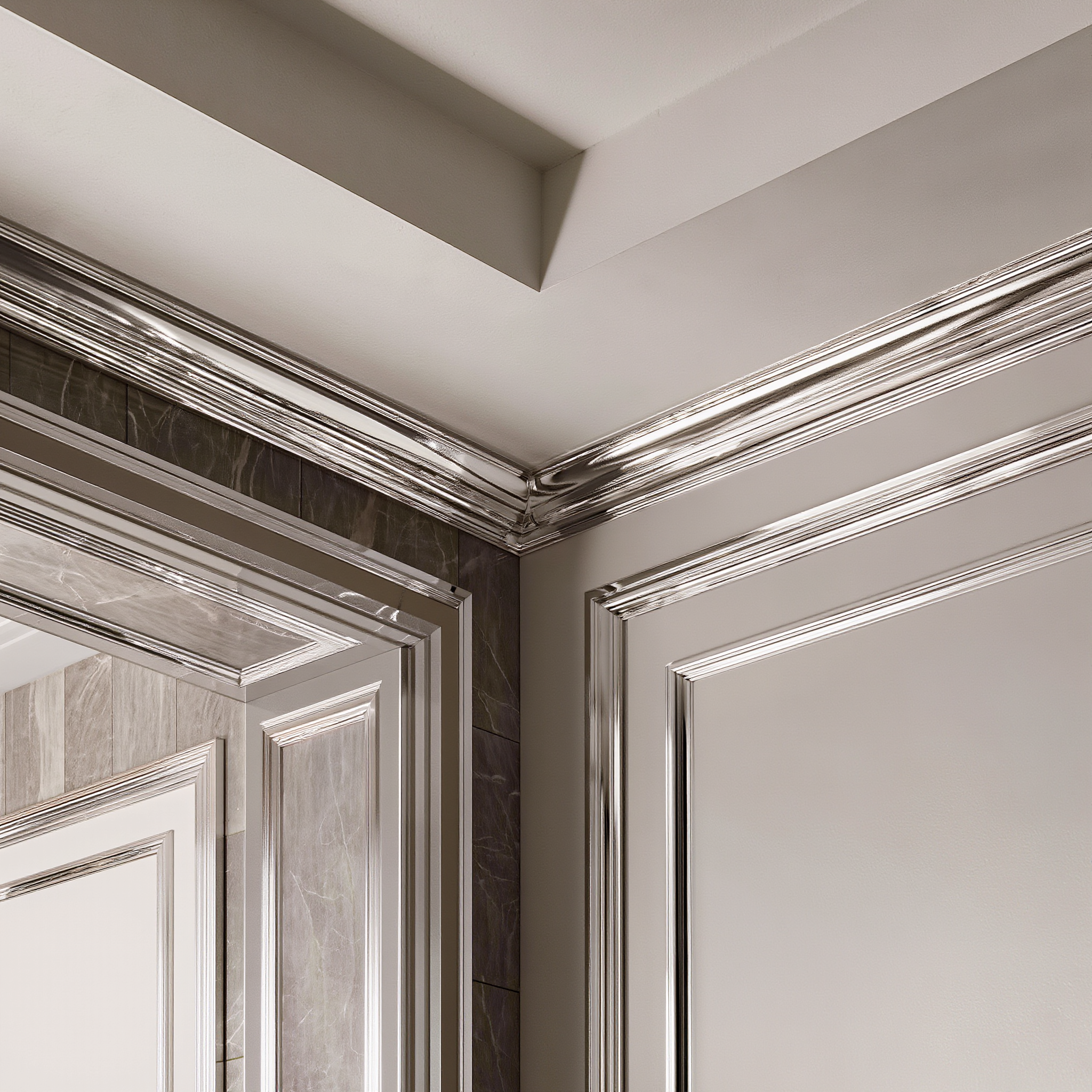
Delineating Form: Accentuating Soffits, Reveals, and Trim
Silver is highly effective when used to delineate architectural form. Soffits, recessed reveals, trim bands, niche interiors, stair stringers, ceiling coffers, column details, and built-in shelving can all benefit from a true silver finish.
The key is restraint. Silver becomes more powerful when it is placed with intention.
A small reveal finished in real silver can sharpen the entire room. A silver soffit can frame a view. A silver trim line can separate planes with jewelry-like precision.
Used this way, silver does not overwhelm the architecture; it defines it.
This is where Aether Vernice can position silver as architectural jewelry without relying on ornament. The material itself becomes the detail.
Bespoke Finishes for Furniture and Fixtures
A .999 fine silver coating is also well suited for selected furniture and fixture applications, provided the substrate and topcoat system are appropriate.
Console tables, cabinet fronts, wall panels, doors, vanity faces, decorative screens, and custom millwork can be transformed into luminous design objects.
Substrate preparation becomes critical. Wood, MDF, metal, plaster, and composite surfaces each require the correct primer and sanding schedule. High-touch surfaces may require a compatible protective clear coat to improve abrasion resistance and cleanability.
The finish should be specified as a complete system, not as a single decorative layer.
When executed properly, the result is a piece that carries the presence of metal without the fabrication constraints of solid metal.
Interplay with Light Design: A Symbiotic Relationship
Silver coatings should be designed in conversation with lighting. The finish will respond differently under warm dimmed LEDs, cool architectural lighting, daylight, indirect coves, grazing beams, and decorative fixtures.
The same wall can appear soft and atmospheric under diffuse light, then bright and dimensional under directional illumination.
For designers and architects, this creates opportunity. A silver surface can be used to tune the emotional temperature of a space.
Warm lighting can make silver feel intimate and champagne-like. Cool lighting can make it feel futuristic and gallery-like. Moving daylight can create a living surface that changes from morning to evening.
A silver coating is not finished when it dries. It is finished when the light touches it.
Frequently Asked Questions
How does the optical performance of a .999 fine silver coating compare to high-quality aluminum or pearlescent finishes?
A .999 fine silver coating differs from aluminum or pearlescent finishes in both material identity and optical behavior.
Aluminum can produce strong brightness, but it often reads more industrial or synthetic. Pearlescent mica can create soft iridescence, but its effect is usually more diffuse and mineral-like. True silver provides a cleaner, more chromatically neutral metallic response with a refined luminous character.
That said, a silver architectural coating is not the same as a polished silver mirror. Its performance depends on particle size, particle loading, binder clarity, film thickness, topcoat selection, and application method.
The goal is not mirror reflectance. The goal is controlled architectural luminosity.
What measures are engineered into the coating to prevent the tarnishing typically associated with silver?
Silver can tarnish when exposed to sulfur-containing gases and other environmental factors, forming silver sulfide on the surface.
A high-performance silver coating addresses this through encapsulation, binder selection, dispersion control, and, when appropriate, compatible protective clear coats.
The binder functions as a protective matrix that reduces exposure between the silver particles and the surrounding atmosphere. The system must be engineered carefully because excessive encapsulation can mute the silver’s optical effect, while insufficient protection can make the finish more vulnerable to discoloration.
Are there specific substrate preparation or top-coating requirements for ensuring the finish’s longevity?
Yes. Substrate preparation is essential.
The surface should be clean, dry, stable, and properly primed. Imperfections should be corrected before application because metallic finishes can emphasize surface irregularities.
For high-touch or moisture-prone areas, a compatible protective topcoat may be recommended.
The exact system depends on the substrate and use case. A ceiling accent, a powder room wall, a cabinet face, and a furniture piece do not experience the same wear.
The best specification should account for abrasion, cleaning frequency, humidity, light exposure, and desired sheen.
Beyond its visual properties, how does the coating’s thermal emissivity and conductivity differ from standard acrylic or latex paints?
Bulk silver has extremely high thermal conductivity compared with organic paint films. Silver is also important in low-emissivity glass coatings because it reflects infrared energy effectively when used in engineered thin-film stacks.
However, a silver-infused architectural paint should not be described as behaving like a solid silver sheet or a low-e window coating.
In a decorative coating, silver particles are suspended within a polymer matrix. The effective thermal behavior depends on loading level, particle connectivity, surface roughness, topcoat, film thickness, and whether the silver forms a continuous conductive pathway.
In practical design language: silver can contribute distinctive optical and material behavior, but energy-performance or thermal-control claims should be supported by product-specific testing.
Conclusion: Silver as an Architectural Material
The Argentum Effect is the difference between color imitation and material presence.
A conventional silver paint attempts to reproduce the appearance of silver. A .999 fine silver coating introduces the element itself into the architectural surface.
This changes the conversation. The finish is no longer merely decorative. It becomes optical, elemental, atmospheric, and collectible.
It carries the language of bullion, jewelry, mirrors, light, and luxury interiors. It allows designers to work with silver not as an accessory placed inside a room, but as a material integrated into the room’s skin.
Aether Vernice .999 fine silver coatings belong to this emerging category: precious architectural finishes for designers, architects, builders, and clients who want more than color.
They want substance. They want luminosity. They want walls that do not simply receive light, but refine it.
This is not silver-colored paint.
This is Argentum applied to architecture.